Employee Handbook Software
Turn Your Notion Handbook Into a Secure Employee Portal
Your policies, SOPs, and onboarding docs already live in Notion. HelpKit publishes them as a searchable portal on your own domain, protected by password, email list, or your existing company login. Your team gets answers; nobody needs a Notion account.
The Best Companies Are Using HelpKit






Sharing the raw workspace is messy
Inviting every employee into Notion means workspace clutter and accidental edits. A published portal is read-only by design: your team reads the handbook, only editors touch the source.
Handbook tools go stale
Move the handbook into a separate wiki tool and it starts drifting from reality the same week. With Notion as the single source, every edit publishes to the portal automatically.
Sensitive content needs real access control
Compensation policies and internal processes can't sit behind a public link. Choose password protection, an approved email list, or JWT auth so your existing login system decides who gets in.
What you get
Everything included, nothing to build
Protected access, up to JWT
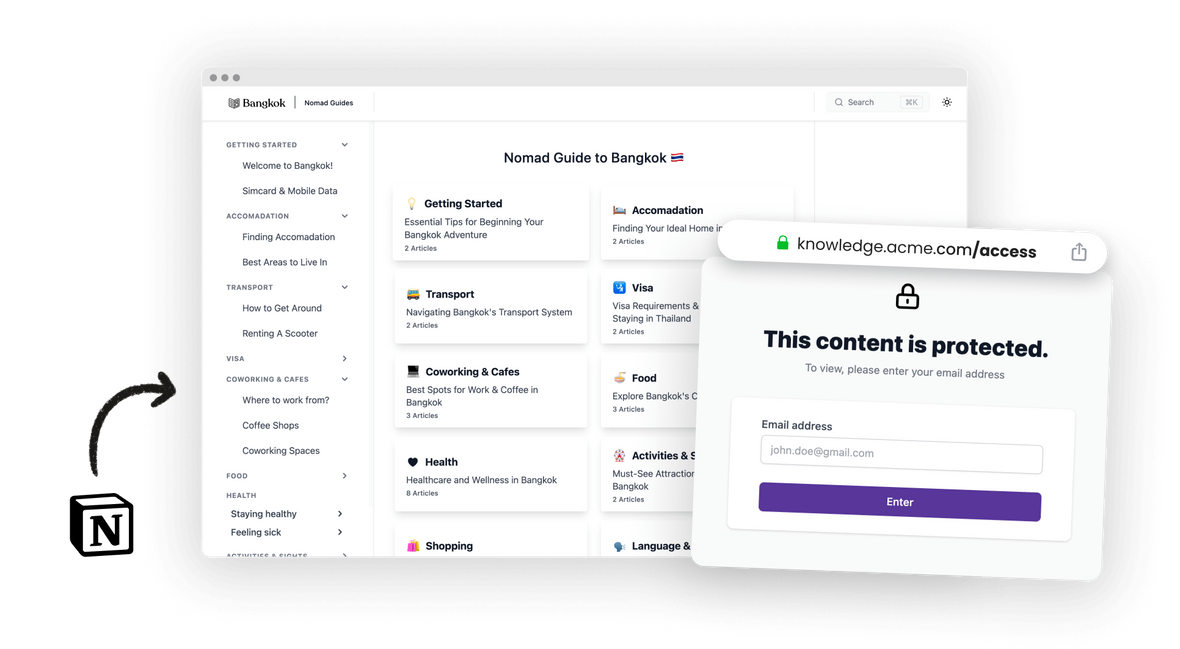
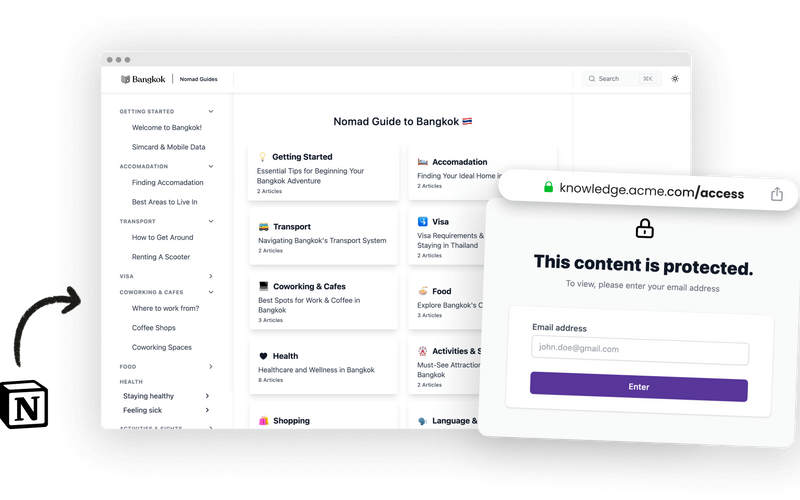
Password, email list, or JWT authentication: if someone is signed in to your company systems, they can read the handbook. If not, they can't. No Notion help center rival offers this.
AI answers for your staff
New hires ask questions in plain language ('how do I submit expenses?') and get answers pulled from your own handbook, with links to the source page.
Search that actually finds things
Full-text search across every policy and SOP, forgiving of typos and phrasing. The end of 'where is that doc again?' messages.
Your domain, your brand, always in sync
handbook.yourcompany.com with your logo and colors. Content syncs from Notion automatically, so the portal is never the outdated copy.
Control exactly who gets in with protected access
A handbook is only useful if the right people can read it and nobody else can. HelpKit publishes your Notion pages as a portal and then locks it down with the access model that fits your company.
-
Password protection
- Protect your whole site with a single password. The simplest and most efficient access control, and you can rotate it whenever you need to.
-
Restricted email list
- Define exactly who can access your site with an approved email list. It lives in Notion, so it works with Zapier and Make out of the box.
-
Custom backend authentication
- Authenticate visitors with your own login system and fully control who gets in. Ideal for internal documentation and enterprise portals.
Powered by HelpKit AI
Your staff ask, the handbook answers
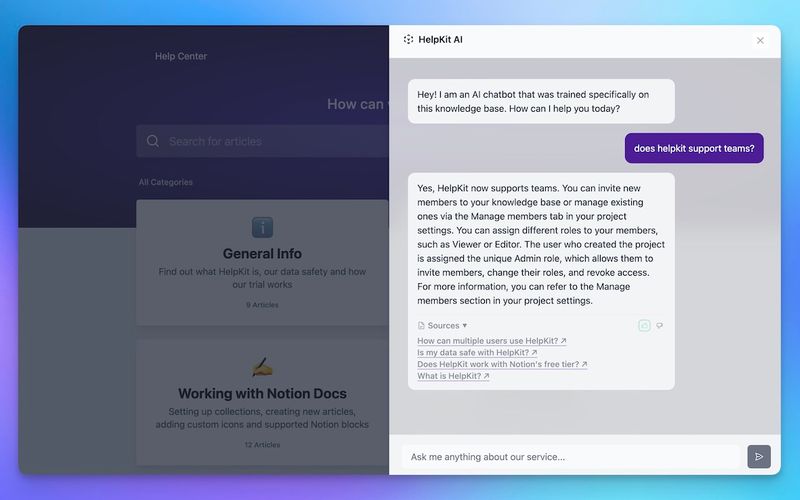
New hires never know which page holds the answer. HelpKit AI is trained on your handbook, so they ask in plain language and get the policy back with a link to the source page.
- ✓"How do I submit expenses?" gets answered in seconds, not in Slack
- ✓Every answer cites the handbook page it came from
- ✓Works inside your protected portal, so private policies stay private
Why your docs belong in Notion
The docs tool your team already knows how to use
Everyone can edit, today. Your team writes in Notion already, so there's no docs platform to learn, no markdown to teach, and no developer bottleneck between "we should update that article" and it being updated.
Docs stay current. Documentation goes stale when updating it is a chore. Editing a Notion page is not a chore, which is why Notion-based docs actually get maintained.
One source of truth. Your knowledge lives in one workspace instead of being copy-pasted into a separate docs system that drifts out of date the same week.
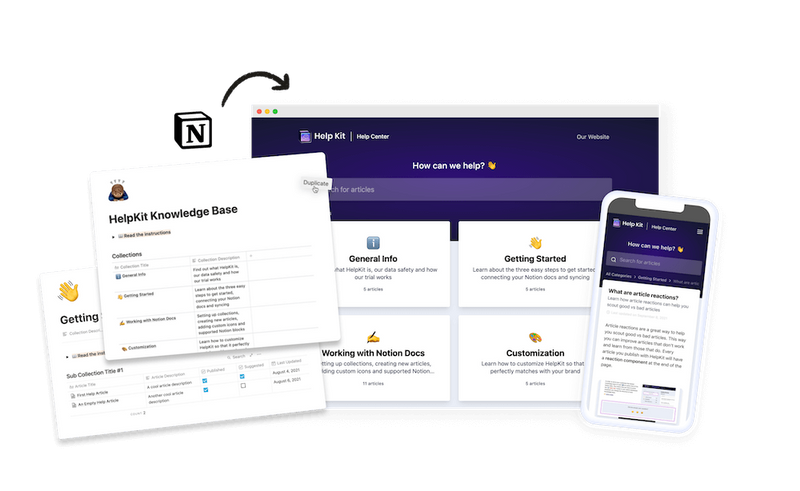
HelpKit adds the pro layer. Notion is the editor; HelpKit is the publishing engine: your domain, search, AI answers, analytics, and access control on top of the pages you already have.
How it works
Your employee handbook, live in three steps
- 1
Write in Notion
Keep your handbook where your team already writes it, or start from our structured template.
- 2
Connect HelpKit
Link your workspace, pick your access protection, connect your domain. About 15 minutes.
- 3
Share one URL
Your whole team gets a searchable, AI-answering handbook. Updates publish themselves.
Teams from software companies to universities run their internal knowledge on HelpKit, alongside 1000+ companies using it for customer-facing docs.
Included on every plan
Everything a professional site needs
Fully branded
Your logo, colours and typography. No HelpKit badge on paid plans.
Your custom domain
Serve on help.yourdomain.com with SSL included, so SEO authority stays yours.
Multilingual
Run several languages from one workspace, without a duplicate system per market.
Instant search
Full-text search that returns answers as visitors type, across every article.
Insights that name gaps
See what people searched for and did not find, so you know which article to write next.
Protected access
Public, password, email allow-list or JWT via your own login. Set it per project.
Embeddable widget
Answers inside your product, without sending anyone out to a browser tab.
AI-readable by default
llms.txt and clean semantic markup, so assistants can quote your docs correctly.
Edits go live instantly
Publish from Notion. No rebuild, no release, no ticket to the web team.


With Helpkit we literally went from 0 to fully functional knowledge-base in 1 hour! The best thing about Helpkit is it allows my non-technical co-founder to do 95% of the work and manage our knowledge-base. We signed up because of how beautiful and well-designed the product is!

Testimonial from Dan Kelly
CEO at Adjust Square
Frequently asked questions
Do my employees need Notion accounts? +
No. The portal is a regular website on your domain. Employees open it in any browser, authenticate through the protection you chose (password, email list, or your company login via JWT), and read. Only the people who edit the handbook need access to your Notion workspace.
Can we use our existing company login? +
Yes. HelpKit supports JWT authentication, which means your current login system controls access to the handbook. Anyone signed in to your app or intranet can open the portal without a second password; anyone who leaves the company loses access automatically when you deactivate their account.
What happens when we update the handbook in Notion? +
The portal updates automatically. Edit the Notion page, and the published version syncs without any exporting, rebuilding, or asking IT. That is the whole point: the handbook people read is never an outdated copy.
Is this only for employee handbooks? +
The same setup works for anything internal you write in Notion: SOPs, IT documentation, onboarding guides, and client portals where each client gets protected access to their own material.
How is this different from a public help center? +
Same engine, different audience. HelpKit publishes a public help center for your customers or a protected portal for your team, and many companies run both from the same Notion workspace as separate projects.
 Ready to turn your
 Notion pages into a
professional
Join 1000+ happy customers reducing their support ticket load and getting customers to their answers quickly.